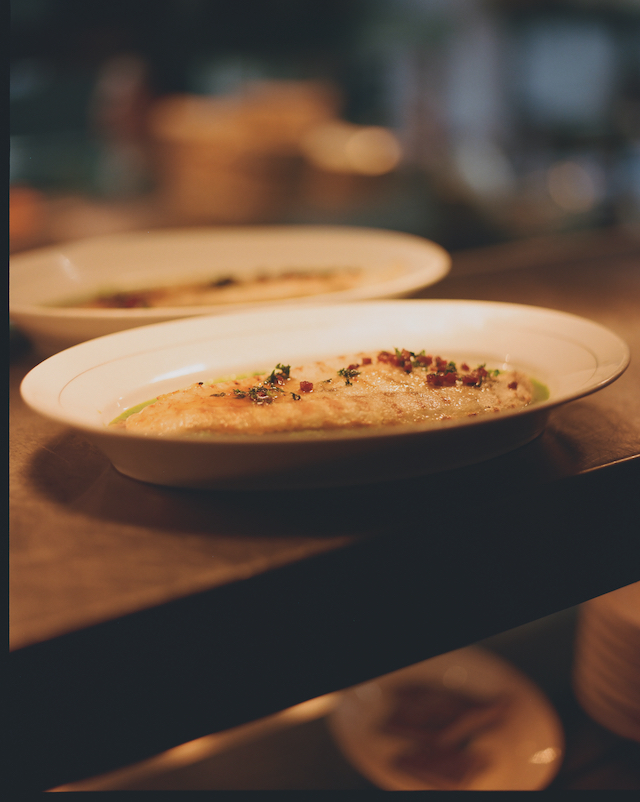
Brill with Caldo Verde

Nuno Mendes shares his twist on a classic Portuguese dish
Photography Francis Augusto

Caldo verde is one of Portugal’s most special, heart-warming dishes. The quality of the chouriço and the potatoes makes a big difference, so get the best you can. I have added extra kale, as it enhances the beautiful jade colour. Traditionally, caldo verde is made with water, but I prefer to use fish stock for a denser flavour – my countrymen will kill me, but I am prepared to stand my ground.

Serves 4

Ingredients

1 Brill

3 tablespoons olive oil

150g chouriço, skin removed and diced, plus a few thin slices to garnish

2 medium onions, finely chopped

2 garlic cloves, crushed

1 fresh bay leaf

4 medium potatoes, such as Maris Piper or similar, diced into small pieces

1.5 litres fish stock 

200g kale, finely chopped

Extra virgin olive oil, to serve

White wine vinegar, to serve

Sea salt flakes and ground white pepper


Heat the olive oil in a pan on a medium heat. Add the chouriço and cook for a couple of minutes, then add the onions, garlic and bay leaf, season with salt and pepper, and cook until the onions are soft. Add the potatoes and sweat for a few minutes, stirring so they don’t stick. Pour in the stock and simmer gently over a low heat until the potatoes are soft. Remove a few tablespoons of the potatoes and set aside.

Add half the kale to the soup and simmer for a few minutes. Remove the bay leaf, take the soup off the heat and blend until smooth with a stick blender. (Traditionally the soup is not blended, but I like to blend, adding some more fresh kale at the end.) Return the pan to the heat and taste for seasoning.

Fillet the fish and make 200g portions. Place it in a tray skin-side up inside the fridge, so it can dry nicely. Remove from the fridge just 10 minutes before you cook it, so it can gain some temperature.

Make sure you have nice and hot embers on the grill. Cook the skin-side down first, so you can get a nice and crispy skin, for around five minutes. After this, turn it and give a nice sear for three minutes more. Take out of the heat and let it rest. Garnish with diced chouriço and fried kale.

Pour the caldo verde on the plate and add the fish on top. Finish with extra virgin olive oil, white wine vinegar and sea salt.

Photography Francis Augusto

Photography assistant Gabriela Velasco
This article is taken from Port issue 30. To continue reading, buy the issue or subscribe here
Lisboeta

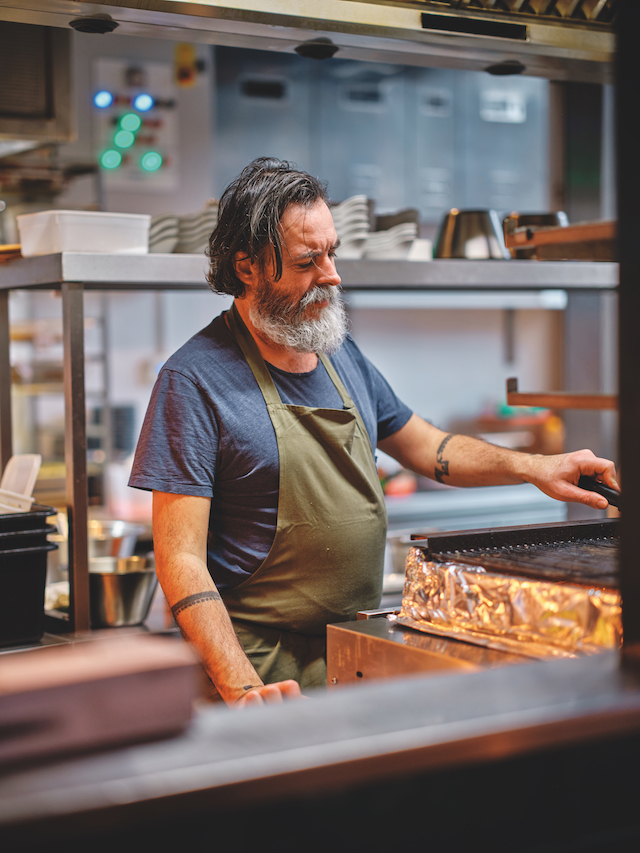
Following the opening of his new restaurant, Nuno Mendes tells of his love of Lisbon

Nuno Mendes, photography Francis Augusto

Lisboa is a city of organised chaos. Bohemian, bustling, eclectic – the layers of competing buildings, one on top of the other, suggest a laissez-faire approach to architecture. If you were to excavate its cobbled ground, I’m sure you’d find a whole metropolis buried beneath. Yet strangely, it works. The endless views and vantages from alleyways and hills are gifted by a particular quality of light, pastel pink. Things are happening, moving; there is an energy that welcomes you. The city is in bloom: but it wasn’t always so.

As a youth my hometown was hurting. Beautiful structures left derelict, no money, no work, people hooked on heroin – it was bleak. You know the refrain in ‘God Save the Queen’ by The Sex Pistols, “no future”? Too many people were living like that. I was fortunate because my grandmother instilled her passion for food in my dad. He encouraged me to be curious. Back in the ’70s and ’80s, the culinary scene was nowhere near as vibrant; you needed to know where to go. My father would take me to experience real Portuguese cooking, seafood on the waterfront, as well as Goan, Greek and Japanese restaurants – it was life-changing learning about these cuisines at such an early age. He passed on his cooking bug, and I left to train in San Francisco, New York and Spain, amongst others. Despite it being a short visit, I was enlightened by my experiences in Japan, and eventually settled in east London.

I’ve often felt like an outsider looking in, someone who’s from Portugal but not living there, shouting words of encouragement from the sideline. For the past decade I have been researching and championing Portuguese food, a subject we have been nationally shy about. We remain defined by early modern history, our mercantile exploration and ‘age of discovery’ leaving traces of Africa, Brazil, India, China, Japan (among many others) on our cooking, and vice versa. For a long time, I believe we were trying to appease visitors with what we thought they wanted, hiding our global roots, our regional – and delicious – ‘peasant food’, our wonderful indigenous ingredients. Culinary tradition was not being passed on, that artisanal knowledge was dying out. I wanted to be part of a movement that celebrates our heritage and am proud to have opened a number of projects in the capital since. Now, I am able to realise another dream with Lisboeta, in London.

Its premise is to showcase the spirit of the city. To capture its daily rhythm, its hospitality, whether that’s through a casual pastéis de nata with a morning coffee, or petiscos (small plates) in the evening. Items will come and go, but you can expect bacalhau, goose barnacles, sea urchins, red mullets, chouriço, alheira, clams and red prawns, as well as local ingredients through a Lisbon lens. Reflecting our melting pot, there will be a little bit of Macau, dashes of Brazil, Mozambique, light touches of Japan. And, while honouring tradition, we will offer our personal interpretation of dishes, producing a singular identity not solely defined by what has gone before.

They say absence makes the heart grow fonder. Every time I’ve moved country, I have stopped by Lisbon to see whether I could make a proper home there again. For one reason or another, it was never the right time. I am turning 50 soon and my native city is calling me; in all my life this is the closest I’ve been to returning. Until then, my slice of Lisboa in Fitzrovia will have to do.

As told to Tom Bolger

lisboeta.co.uk

Photography Francis Augusto

Photography assistant Gabriela Velasco

This article is taken from Port issue 30. To continue reading, buy the issue or subscribe here